Odds Generation — run · inning (cricket)
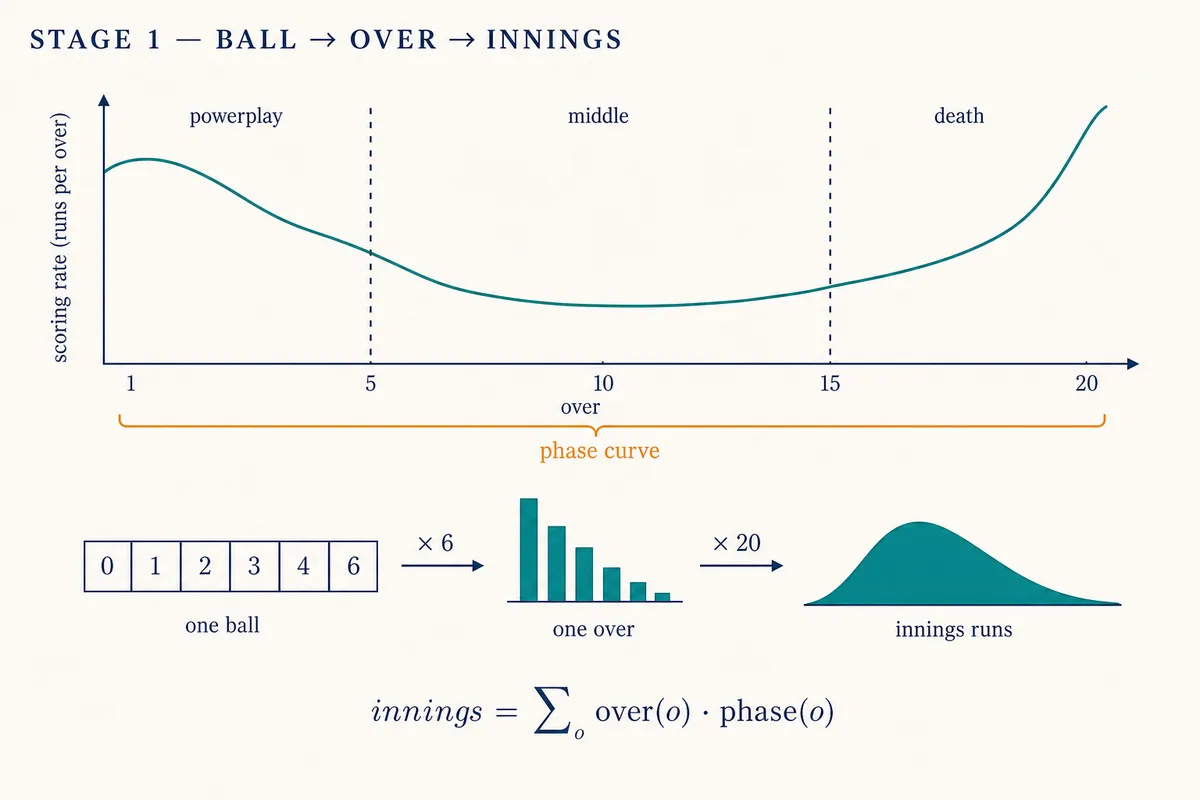
Pick the format (T20/ODI), say who bats first, and enter the batting-first innings total in Malay plus the Match Winner in decimal — margins still embedded. A limited-overs innings is overs of six balls scoring {0, 1, 2, 3, 4, 6}, so the model is compound from the ball up (ADR-029):
- strips both margins (Power method) to fair targets;
- builds ball → over → innings under a phase curve (powerplay / middle / death — cricket's quarter weights) and back-solves the two innings abilities: the innings line fixes μ₁, the Match Winner fixes μ₂;
- independent overs come out far too thin (σ ≈ 15 vs ≈ 28 real), so a day-form mixture G = 1 + τZ scales every over and τ is solved to the dispersion prior — collapses and flat tracks correlate overs;
- the chase truncates: the second innings stops at the target (won chases pile up just past it, failed ones fall short), scores level is the tie — the 1X2's third leg, settled by the super over in T20 — so 2nd-innings Over/Unders price off the settled distribution, not the ability;
- group runs (the powerplay) and single-over markets read the same phase curve and mixture, consistent with the innings by construction.
Wickets and resource decay are folded into the phase curve and mixture rather than modelled per ball — the honest limit of a quotes-anchored page; ball-level state belongs to the ADR-029 phase-2 engine.
↑/↓ steps a field, Shift steps bigger; the Malay pair steps its partner the opposite way. Quotes: the batting-first innings total + the match winner; the second innings and every segment derive from the same model.
Valid inputs: Malay in [−1, +1] non-zero, decimals above 1, each book carrying margin, σ above ~8. The solve mixes 7 form nodes over 20 overs — allow it a second or two.
| 90 | 100 | 110 | 120 | 130 | 140 | 150 | 160 | 170 | 180 | 190 | 200 | 210 | 220 | 230 | 240 | 250 | |
|---|---|---|---|---|---|---|---|---|---|---|---|---|---|---|---|---|---|
| Innings 1 (Home) | 0.2 | 1.0 | 2.7 | 5.4 | 8.4 | 11.1 | 12.9 | 13.5 | 12.8 | 10.9 | 8.5 | 5.9 | 3.6 | 1.9 | 0.9 | 0.3 | 0.1 |
| Innings 2 (Away) — settled | 0.5 | 2.1 | 5.6 | 10.5 | 14.9 | 17.2 | 16.6 | 13.6 | 9.4 | 5.5 | 2.6 | 1.0 | 0.3 | 0.1 | 0.0 | 0.0 | 0.0 |
| Outcome | Fair | Dec | Priced |
|---|---|---|---|
| Home | 53.5% | 1.868 | 1.800 |
| Draw (tie) | 1.0% | 100.693 | 49.393 |
| Away | 45.5% | 2.199 | 2.109 |
How these numbers are computed
| Over | Under | |
|---|---|---|
| Malay quote | +0.90 | +0.92 |
| Decimal | 1.9000 | 1.9200 |
| Implied | 0.5263 | 0.5208 |
| Fair | 0.5028 | 0.4972 |
| Fair decimal | 1.9888 | 2.0113 |
| Home | Away | |
|---|---|---|
| Decimal quote | 1.80 | 2.10 |
| Decimal | 1.8000 | 2.1000 |
| Implied | 0.5556 | 0.4762 |
| Fair | 0.5403 | 0.4597 |
| Fair decimal | 1.8509 | 2.1752 |
Standalone strips: Margin — two-way (Power).
A ball scores {0, 1, 2, 3, 4, 6}; six balls convolve into an over, and the innings convolves 20 overs under a phase curve — powerplay / middle / death get 29/41/30% of the runs across 6/9/5 overs (cricket's quarter weights). But independent overs give σ ≈ 18.8 — real innings run σ ≈ 28.0 because collapses and flat tracks correlate every over. The fix is a day-form mixture: every over's mean scales by , and τ is solved so the innings dispersion hits the prior:
| Stage | μ₁ | μ₂ | τ | σ₁ | tie | Δ over | Δ ML |
|---|---|---|---|---|---|---|---|
| Overs | 166.0 | 163.4 | 0.000 | 18.8 | 1.5% | 1.9e-7 | 4.3e-7 |
| Form τ | 166.5 | 162.5 | 0.137 | 28.0 | 1.0% | 4.9e-7 | 1.9e-7 |
| Chase | 166.5 | 162.5 | 0.137 | 28.0 | 1.0% | 4.9e-7 | 1.9e-7 |
Each stage re-solves both fair targets: the innings line pins μ₁ (size) and the Match Winner pins μ₂ (the chasing ability) — with ties heading to the super over, the ML read is .
Whoever bats second stops the moment the target falls: with a first-innings score and chasing ability ,
which is why the settled second-innings pmf (the Chase stage in the panel) piles up just past the target and never shows the ability tail — and why 2nd-innings Over/Unders must price off the settled distribution, not the ability. Who wins is truncation-free, so μ₂ matches the Form stage. The tie mass P = 1.0% is the 1X2's third leg.
Three legs: batting-first side wins, scores level (the tie), chasing side wins — read off P(A₂ vs the target). Fair groups are re-margined exactly as in goal-regular (Power ladder two-way, Shin multi-way).
targets  tO = powerStrip(innings pair)     tW = powerStrip(match-winner pair)

stage ∈ {Overs (τ=0), Form τ, Chase}:          # each re-solves the same targets
  sweep: bisect μ₁ until P(runs₁ > line) = tO
         bisect τ  until sd(innings₁)   = σ prior          # Form/Chase stages
  bisect μ₂ until P(chase wins) + ½·P(tie) = tW

innings: ball pmf(mean) → over (6-fold conv) → phase curve over 20 overs
         → mix over day-form G = 1 + τZ (7 nodes)
chase:   r₂ = A₂ if short; = target + overshoot if won; level = tie (super over)
Wickets/resource decay are folded into the phase curve and mixture rather than modelled per ball — the honest limit of a quotes-anchored page (ADR-029 phase 2 owns ball-level state). Engine + invariants: docs/src/lib/odds/cricket.ts, __tests__/cricket.test.ts.